
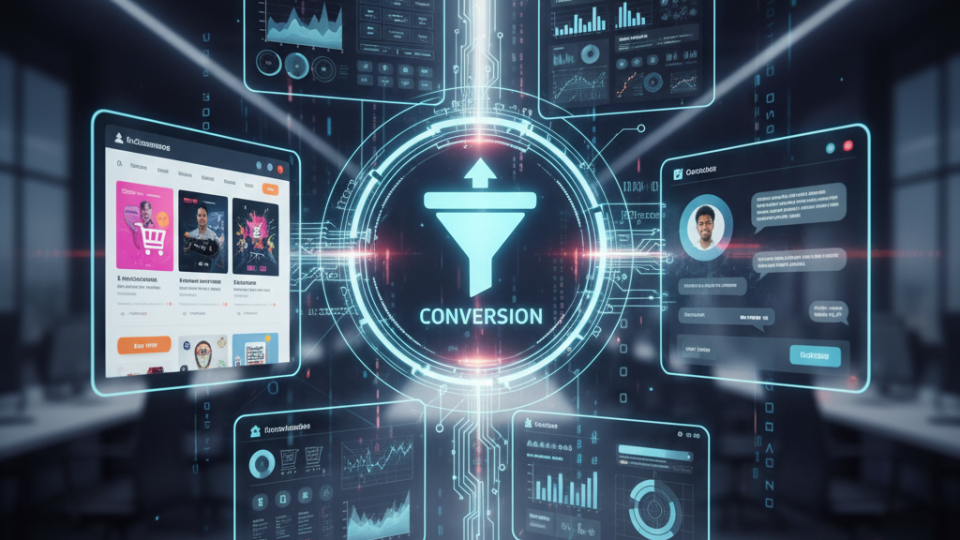
Do you have various AI tools working in isolated pockets across your organization, each doing its part but never truly communicating? Many businesses invest in individual AI solutions for specific problems (a chatbot here, a recommendation engine there), expecting a conversion miracle. The reality is often fragmented results. True, transformative conversion optimization in the AI era doesn’t come from isolated AI features. It comes from seamlessly integrating AI across your entire tech stack, creating a unified, intelligent, and continuously optimizing ecosystem that understands and guides every customer interaction.
Beyond Point Solutions: The Power of Connected AI
The most common mistake businesses make with AI is treating it as a series of point solutions. They implement an AI-powered chatbot for customer service, an AI content generator for marketing, and a separate AI tool for sales forecasting. While each tool might offer incremental benefits, their full potential remains untapped because they operate in isolation. Data from one AI is not informing another. Insights from a marketing AI don’t automatically refine the sales AI’s approach.
This siloed approach misses the synergistic power of integration. When AI tools share data and insights, they create a comprehensive, dynamic understanding of the customer. This enables truly personalized experiences that adapt in real time across every touchpoint. The whole becomes far greater than the sum of its parts. An integrated AI ecosystem is the difference between minor tweaks and massive conversion lifts.
Unifying the Customer Data Spine with AI
Effective AI integration for conversion optimization starts with creating a unified customer data spine. This means breaking down data silos and ensuring that customer information flows freely and intelligently between all your systems. Your CRM, marketing automation platform, e-commerce site, analytics tools, and customer support platforms must all feed into and draw from a central, AI-powered understanding of each customer.
AI plays a crucial role in:
- Data Normalization: Cleaning, standardizing, and deduplicating customer data from disparate sources.
- Customer 360 Profiles: Building rich, dynamic profiles that update in real time based on every interaction across every channel.
- Predictive Segmentation: Using machine learning to automatically group customers into highly specific segments based on their behavior, intent, and value.
When every AI tool has access to this unified, intelligent customer view, it can make far more accurate predictions and deliver far more relevant experiences. This foundational data layer is the bedrock for all subsequent conversion optimization efforts.
Personalization at Scale: From Browsing to Buy
With an integrated AI data spine, you can achieve personalization at a scale and precision previously impossible. This goes beyond simply using a customer’s name. Integrated AI allows you to dynamically adapt every aspect of the customer journey, from their initial website visit to the final purchase.
Consider these scenarios:
- Dynamic Website Content: An AI integrated with your CMS can change hero images, headlines, and calls to action based on a visitor’s referral source, past browsing history, or real-time intent.
- Personalized Product Recommendations: Beyond “customers also bought,” integrated AI can suggest products based on a customer’s unique browsing patterns, demographic data, and even current inventory levels across multiple channels.
- Optimized Email Campaigns: AI integration allows your marketing automation platform to trigger emails at the optimal time, with hyper-personalized content and subject lines that reflect recent website activity or specific product interests.
This continuous, intelligent tailoring of the customer experience reduces friction, increases relevance, and significantly boosts conversion rates by making every interaction feel like a one-on-one conversation.
Proactive Engagement and Predictive Lead Nurturing
AI integrations also enable a powerful shift from reactive to proactive engagement and predictive lead nurturing. Instead of waiting for a customer to act or an agent to intervene, integrated AI can anticipate needs and intervene at crucial moments.
- Behavioral Triggers: AI monitoring website or in-app behavior can detect signs of confusion or high intent. For example, if a user hovers over a pricing page for an extended period, an integrated chatbot might proactively offer a guided tour or a specific discount.
- Lead Scoring and Prioritization: By integrating AI across sales and marketing platforms, the system can continuously score leads based on their engagement, demographic fit, and predictive buying signals. This allows sales teams to prioritize high-value leads and receive automated alerts for optimal outreach times.
- Churn Prevention: AI analyzing customer usage patterns can identify early signs of dissatisfaction or disengagement. Integrated systems can then trigger targeted interventions (an automated check-in email, a special offer, or an alert to a customer success manager) to proactively address potential churn.
This predictive power of integrated AI transforms lead nurturing into a highly efficient, automated process that pushes conversions forward.
Automating A/B Testing and Continuous Optimization
One of the most significant advantages of leveraging AI integrations is the ability to conduct automated A/B testing and continuous optimization across your entire conversion funnel. Traditional A/B testing can be slow, resource-intensive, and often limited to a few variables. Integrated AI changes this game.
By connecting your AI optimization engine with your website, email, and advertising platforms, the AI can:
- Run Thousands of Variations: Simultaneously test countless combinations of headlines, images, copy, and CTAs across different segments.
- Identify Winning Strategies: Learn in real time which combinations perform best for which specific user profiles.
- Dynamically Implement Changes: Automatically deploy the winning variations, continually improving performance without manual intervention.
This always-on optimization ensures your conversion strategies are constantly refined, adapting to changing market conditions and evolving customer preferences. It’s a never-ending cycle of learning and improvement that drives sustained conversion growth.
The future of conversion optimization isn’t about isolated AI features. It’s about a fully integrated, intelligent ecosystem where every AI tool works in harmony, sharing data and insights to create a seamless, hyper-personalized customer journey. This synergistic approach not only drives immediate conversion lifts but also future-proofs your business by building a continuous learning and optimization engine.
How integrated are your current AI tools? Audit your tech stack today and identify one key area where connecting existing AI capabilities could dramatically improve your conversion rates.