
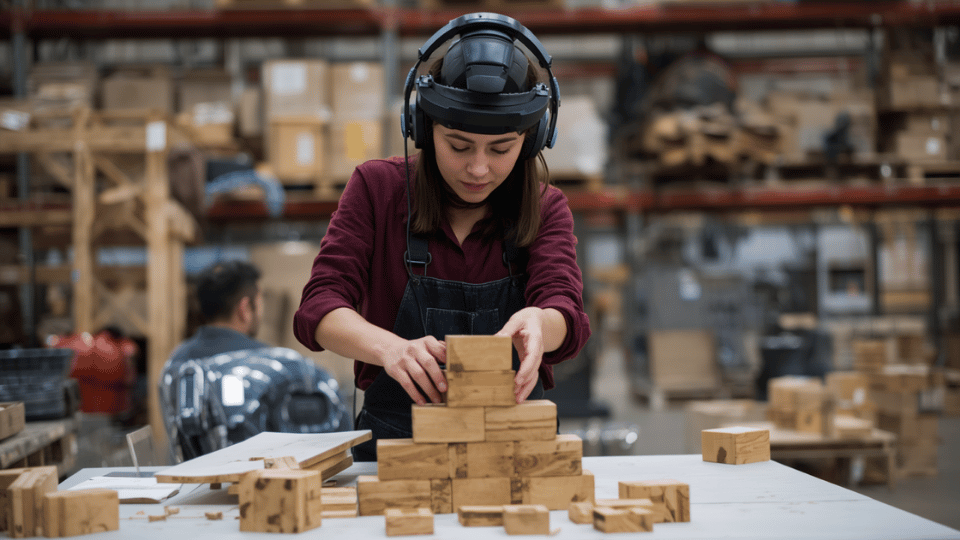
Inside a warehouse in San Leandro, California, a worker stacks wooden blocks on a table while wearing a heavy headset. She is not building toys or running through a standard manual labor shift. She works for Encord, a company focused on generating specialized training data for physical artificial intelligence models and robotic systems. The headset on her head houses sensors that measure her brain activity, focus, and intent as she carefully stacks each block.
Encord belongs to a growing group of startups moving past text and web-based data. Instead of scraping articles or public websites, these companies create physical training data directly. They hire human workers to execute manual tasks while capturing every movement, eye angle, and neural signal. This approach builds a rich layer of real-world data to help robotics companies train smarter hardware.
The specialized headset comes from Zander Labs, a German startup that builds devices to measure brain activity. The hardware tracks mental states like focus, fatigue, and frustration. Engineers run these neural signals through custom prediction models, helping AI systems understand human intent before a physical action even takes place.
Lucas Gehm, a lead neuroscientist at Zander Labs, explains that tracking brain activity shows which parts of a task require intense focus. That data helps developers teach robots where they need to deploy extra computing power or slow down their movements to avoid mistakes.
Encord co-founder Vincent Verbruggen leads the effort to solve what he calls the physical AI data bottleneck. Before founding Encord, Verbruggen worked as head of robotics training at Tesla. He points out that companies building self-driving cars and humanoid robots hit a wall because high-quality real-world data remains scarce. While standard video helps robots see their surroundings, it lacks the depth needed to master complex hands-on tasks like picking up delicate items or assembling tiny parts.
To solve this problem, Encord collects egocentric video using head-mounted cameras, smart glasses, and motion sensors. Human trainers wear the gear while pouring coffee, moving fragile objects, and organizing tools. By adding brain wave monitoring and muscle sensor data to those video recordings, Encord creates multi-layer datasets that teach robots how humans think and move during manual tasks.
Collecting this physical data costs far more than pulling text off the internet. Verbruggen notes that generating high-quality physical training data can cost up to one hundred times more than standard web scraping. However, robotics companies view that high cost as a necessary investment. Teaching software how to interact with physical objects requires real-world trial and error.
By combining neural signals, motion tracking, and first-person video, startups like Encord and Zander Labs are building the foundational data engines for physical AI. Their work gives future robots the fine motor skills and spatial awareness needed to operate safely alongside humans in warehouses, factories, and homes.