
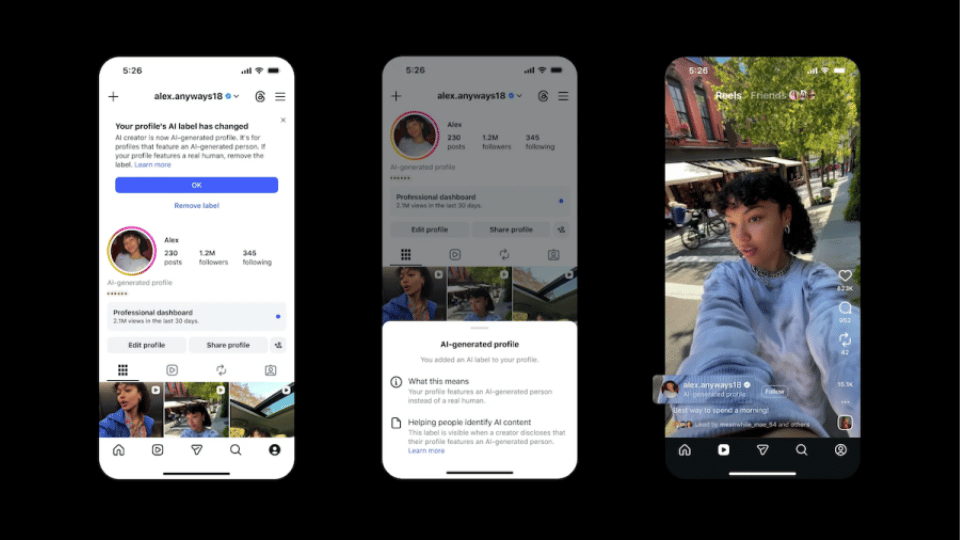
Instagram announced Monday that it is changing how it tags synthetic profiles while actively restricting account reach for creators who post computer-generated human personas without giving proper disclosure.
The company is updating its existing “AI creator” tag to read “AI-generated profile” instead. Instagram stated that the new wording makes the status easier to spot, clarifying that the persona featured across the account was built or modified heavily using generative software tools.
Under this updated enforcement policy, account owners who fail to disclose synthetic avatars face immediate reach penalties, limiting how frequently their posts appear in discovery feeds and recommendation reels. Account owners who apply the mandatory label correctly will not face reach penalties simply for publishing synthetic persona content.
This specific profile tag applies exclusively to synthetic humans rather than everyday photo edits. Creators who use smart editing software to touch up lighting, polish image captions, or generate background graphics do not need to apply the full profile label.
Instagram rolled out these strict changes following heavy user backlash over deceptive virtual accounts that look like real people. Users expressed frustration after following profiles for weeks, only to discover later that the account owner created the entire persona out of digital code.
This policy shift comes as synthetic influencers multiply across popular social apps, causing real-world harm. Earlier this year, an investigation uncovered a coordinated network of fake male profiles promoting a dating app. The investigation flagged dozens of synthetic profiles reaching out to real users via direct messages to push app signups.
Health and wellness content presents an even bigger issue. Recent reports revealed hundreds of synthetic doctors, natural healers, and health personalities marketing dietary supplements and making unverified medical claims to everyday followers.
The policy update follows recent user pushback over an internal tool that let people generate images using existing user likenesses without explicit permission. Instagram removed that feature after public complaints.
At the same time, parent company Meta agreed to an $18 billion settlement with United States state leaders regarding youth safety. As part of that agreement, Meta will enforce automatic daily usage limits for teenagers, block night notifications, and mute alerts during normal school hours across its main platforms.
Forcing clear labels on synthetic personas helps maintain account transparency while stopping deceptive marketing tactics before they spread. As digital creation tools become easier to access, social networks must enforce clear rules to help users distinguish real people from generated avatars.
When creators run synthetic personas without clear disclaimers, followers lose trust in the broader platform ecosystem. Transparency rules give users full control over the content they choose to support online. Setting clear boundaries ensures that virtual characters do not manipulate audiences through deceptive messaging.
Furthermore, platforms must continually refine detection algorithms to catch accounts trying to bypass disclosure tags. Combining automated detection models with community reporting features creates a safer browsing space for everyday mobile app users.