
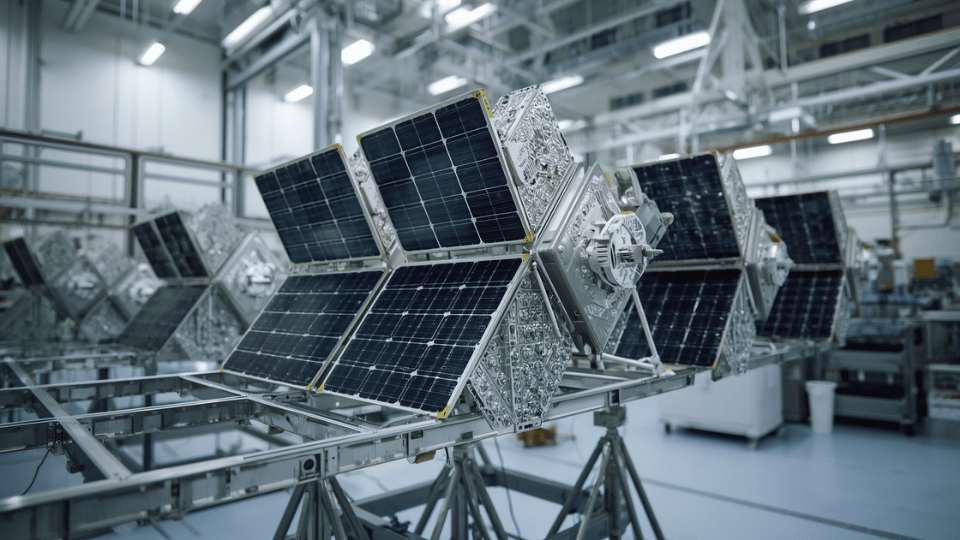
Google’s prototype orbital compute satellite took off aboard a SpaceX rocket from California, marking the first time the search giant deployed one of its specialized processing chips into space. Built by Planet Labs, the satellite aims to prove that a Google Tensor Processing Unit can function in space conditions by supplying continuous power, managing thermal systems, and running model tests. Executing this mission serves as the first step in Google’s Project Suncatcher, an ambitious plan to build large-scale compute clusters in orbit around Earth.
Once fully commissioned, the test satellite will fire up its TPU in 15-minute bursts to prevent straining thermal and power systems. While this initial mission uses a standard satellite chassis, Google and Planet Labs are developing larger custom satellites slated for launch next year that will handle substantial processing workloads and test inter-satellite laser links. Project Suncatcher envisions a network of 81 interconnected satellites flying in formation to create a high-capacity orbital data center.
Alongside the satellite deployment, Google released a peer-reviewed research paper examining the technical and economic realities of orbital computing. The analysis provides a realistic assessment of launch costs, hardware durability, and logistics, offering a detailed picture of how satellite computing costs could evolve over time. The paper highlights that building cost-effective space data centers requires massive improvements in heavy-lift launch capacity that current rocket fleets cannot provide.
To make orbital compute clusters economically viable, Google estimates that SpaceX must achieve a massive cost reduction curve on its Starship launch vehicle. Launching an operational orbital data center network requires Starship to lift roughly 370,000 tons of payload into orbit over the next decade. Achieving that payload volume demands approximately 1,800 Starship launches, averaging 180 rocket launches per year assuming a 200-metric-ton capacity per mission.
Reaching that launch frequency presents a tremendous operational challenge for rocket builders. SpaceX has never flown Starship more than five times in a single year, though executive team estimates suggest Starship could eventually reach an hourly flight cadence. On the hardware side, Google tested its processing chips against intense space radiation using particle accelerators, giving engineers confidence that TPU chips can survive five-year satellite lifespans despite elevated error rates during mega-scale processing runs.
Building data centers in space offers an intriguing alternative to ground-based power limitations, but rocket launch logistics remain the ultimate bottleneck. Relying on heavy-lift launch vehicles to deploy thousands of tons of server hardware means space-based computing will remain experimental until rocket reuse reaches commercial scale. Google’s research proves that while processing hardware can survive outer space, placing data centers in orbit depends entirely on the launch industry delivering reliable, ultra-low-cost space access.