
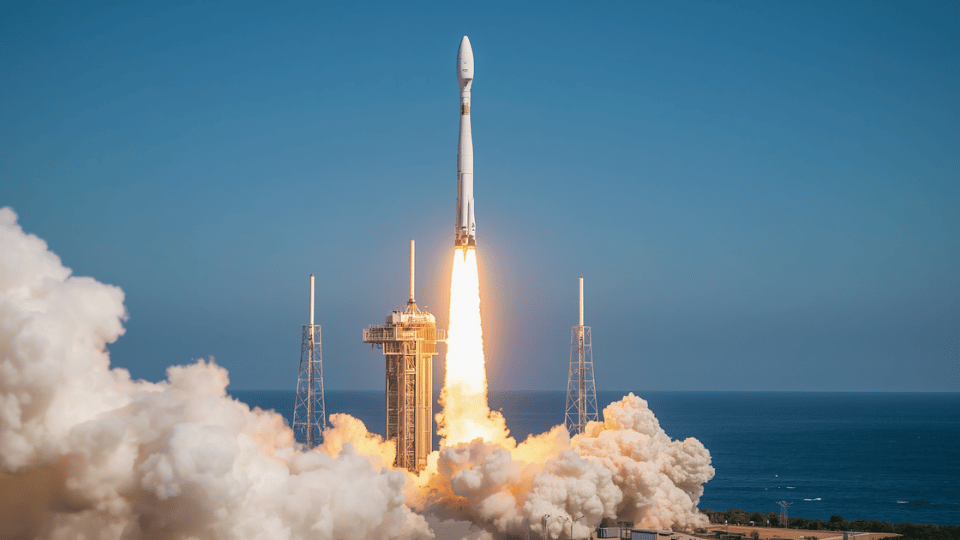
China just shook up the global space race by pulling off a feat that only Elon Musk’s team had mastered until now. The country’s state-owned space group successfully launched a massive Long March orbital rocket and nailed the landing of its booster stage directly onto a recovery vessel floating at sea. This clean touchdown makes China only the second nation on earth to successfully recover an orbital-class rocket booster from the ocean.
The successful Friday trial runs prove that the China Aerospace Science and Technology Corporation is moving fast to challenge the dominant position of SpaceX. For years, reusing rocket components over and over allowed Musk to slash launch prices and dominate the commercial launch sector. Now, the Chinese space program plans to deploy this identical cost-cutting strategy. Engineers announced they intend to prepare this exact salvaged booster for a second flight before the current year ends. In terms of raw capacity, this new Chinese rocket matches the lifting power of the Falcon 9, meaning it can carry a similar weight of hardware into orbit.
While the goal matches SpaceX, the technical execution looks completely different. Falcon 9 rockets deploy heavy landing legs to balance themselves on a floating barge. The Chinese engineering team chose a different path, building a giant frame fitted with high-strength tension nets across their recovery ship to catch the falling rocket as it drops from the sky. To pull this off without a catastrophic explosion, the team relies on advanced steering software, precise location sensors, and rocket engines that can restart reliably mid-air after surviving the extreme heat of atmospheric re-entry.
This breakthrough arrives at a critical moment for global satellite networks. SpaceX currently dominates the skies, breaking its own annual launch records to build out the Starlink internet network. Because of strict national security regulations, China will not compete directly with Musk for western commercial launch clients. Instead, the country will use these cheap, reusable rockets to build its own massive constellation of communication satellites and planned orbital data centers. This infrastructure will help them rival Starlink’s coverage in expanding markets across Africa, the Middle East, and Southeast Asia.
The successful catch also follows a tense week of geopolitical news. Investigative journalists recently uncovered documents showing that Russian and Chinese space networks are actively sharing data to find ways to disrupt or block Starlink signals. This adds a serious layer of competition to the launch race.
For the United States military, this success signals a shifting balance of power in orbit. Up until now, Western forces enjoyed a massive logistical advantage because they could launch intelligence and tracking hardware far cheaper than any adversary. With China dropping its launch costs, that gap closes rapidly. This makes the space race look much more like a level playing field, creating new security headaches for global defense agencies.
Meanwhile, western competitors are scrambling to keep pace. SpaceX is currently preparing another test flight for its giant Starship platform later this month, following a series of mixed test results. Other American firms like Jeff Bezos’ Blue Origin, Rocket Lab, and Stoke Space are also testing their own reusable designs this year, but China’s sea landing proves that the international race for affordable space travel is getting much tighter.