
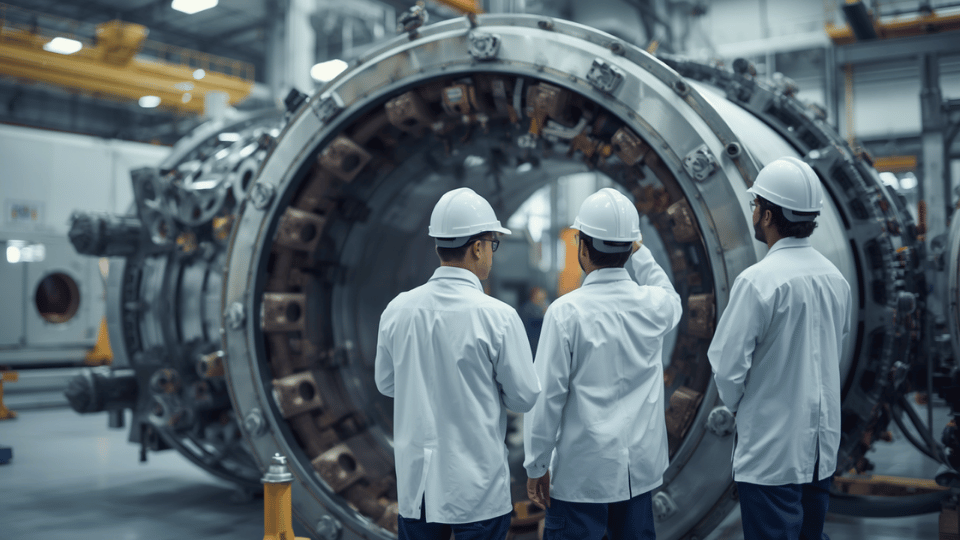
Commonwealth Fusion Systems just secured another $1 billion in fresh funding, extending its lead as the most heavily financed fusion power venture in the world. Significant institutional investors backed the new round, including major pension funds, sovereign wealth funds, and global infrastructure companies. This massive billion-dollar cash injection brings total funding for Commonwealth Fusion Systems to an incredible $4 billion so far.
The new capital comes at a key moment as operational expenses scale up dramatically. Engineers are currently building Sparc, the company flagship demonstration reactor, while finishing technical blueprints for Arc, its first commercial-scale power plant. Chief Executive Officer Bob Mumgaard hinted that the firm will keep raising capital as project construction moves forward. Building advanced magnetic hardware and heavy industrial facilities requires deep pockets, and this fresh capital keeps operations running at full speed.
Neither the company nor public officials have revealed exact price tags for Sparc or Arc. However, former Virginia governor Glenn Youngkin previously called Arc a multi-billion-dollar power facility. This new $1 billion financing round marks the largest raise for the company since it secured $1.8 billion in 2021. Previous funding pushes included high-profile tech investors like Nvidia, Google, Khosla Ventures, and Breakthrough Energy Ventures.
Commonwealth Fusion Systems relies on magnetic confinement to produce power, building massive tokamak machines that use powerful magnetic fields to trap superheated plasma inside a donut-shaped chamber. When atomic nuclei fuse inside that ultra-hot environment, the reaction releases massive amounts of thermal energy. System designs capture that intense heat to boil water, create steam, and drive commercial turbines to generate electricity.
Engineers report strong progress on the Sparc reactor, with internal projections expecting to hit scientific breakeven by 2027. Reaching scientific breakeven means the fusion reaction produces more energy than the magnets and heaters use to ignite it. Hitting that milestone proves to institutional backers that the engineering physics work as intended. To date, only the National Ignition Facility at Lawrence Livermore National Laboratory has achieved net energy gain, using lasers instead of magnetic fields.
Alongside construction on the Sparc test reactor, teams are finalizing designs for the Arc commercial plant planned for Virginia. Major corporate buyers are already lining up to buy output. Italian energy firm Eni committed to purchasing over $1 billion worth of electricity from Arc. Tech titan Google also signed a major commercial agreement to buy 200 megawatts of continuous power, securing half of the total output from the Arc facility to run data centers.
Securing multi-billion-dollar energy purchase agreements gives Commonwealth Fusion Systems clear commercial backing as it builds out physical infrastructure. If engineers hit their 2027 scientific breakeven target, fusion energy will shift rapidly from an experimental physics science project into a viable commercial power alternative for the global energy grid.