
High above the Earth, a new generation of mechanical spacecraft is fixing how operators manage orbital assets. Northrop Grumman built and operates a specialized servicing craft called the Mission Extension Vehicle, or MEV. This week, the MEV craft unhooked itself from a major commercial communications satellite run by Australian provider Optus. For over a year, the MEV vehicle stayed clamped to the back of the Optus satellite, acting as its personal engine so the vehicle could stay in proper alignment and continue running its daily broadcast operations.
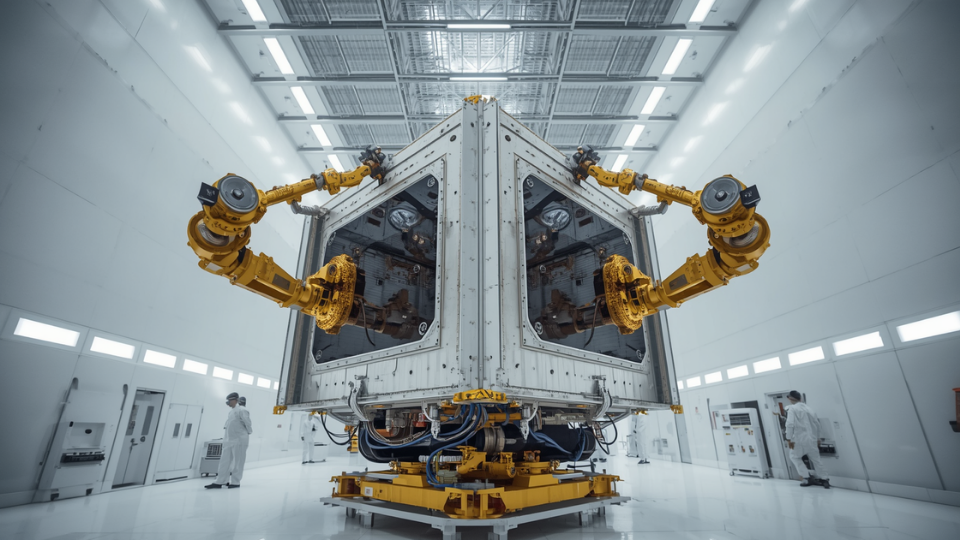
Now, that original life-extension vehicle is moving aside to let a newer mechanical craft take its place. In July, four new Northrop spacecraft launched into orbit aboard a SpaceX Falcon 9 rocket. One of these primary craft is the Mission Robotic Vehicle, known as the MRV. This mechanical servicing unit comes equipped with two advanced robotic arms developed alongside DARPA, the research wing of the United States military. The other three spacecraft are smaller Mission Extension Pods, or MEPs, which function as compact propulsion systems.
All four spacecraft are traveling toward targets parked roughly 27,000 miles above the surface of the Earth. In 2027, the MRV will use its dual robotic arms to attach one of those propulsion pods directly onto the Optus satellite. That upgrade should keep the satellite operational and generating commercial revenue for up to six more years.
Satellites that broadcast media signals or scan Earth weather patterns carry expensive sensors and transmitters. Typically, these systems stop working not because their computers break down, but because they run out of thruster fuel. Without fuel, they cannot maintain their operational orbit. The Optus satellite originally launched in 2009 with a planned 15-year operational lifespan. By attaching a fresh propulsion pod, the owner can keep the system running long past its original retirement date.
Lower launch costs from private rocket companies are turning space repair missions into a viable business model. Cassie Wong, director of logistics and servicing at Northrop, explained that the ultimate goal is building sustainable space operations. Instead of abandoning functional hardware when fuel runs out, companies can repair, upgrade, and maintain active spacecraft directly in orbit.
Northrop currently operates two original MEVs in orbit, launched in 2019 and 2020. Those initial vehicles provided ten years of combined life extension across multiple customers, including two separate Intelsat spacecraft and the Optus satellite. MEV-1 is waiting in a parking orbit for its next commercial client, while MEV-2 remains attached to an active Intelsat satellite until at least 2030.
The new Mission Robotic Vehicle updates this business approach. Instead of leaving a full servicing vehicle attached to one target, satellite operators purchase smaller propulsion pods that attach permanently to their hardware. That design choice frees up the main MRV vehicle to move between multiple targets, giving satellite owners a much cheaper service option.
Executing these orbital repairs requires advanced navigation controls. Two separate spacecraft must approach each other and dock safely while traveling at thousands of miles per hour through space. The older MEVs connect by inserting a docking probe directly into a target main engine nozzle. The newer MRV will use its dual robotic arms to align and latch new propulsion pods onto client hardware.
While many commercial space companies focus on launching large constellations of cheap, disposable satellites into low-Earth orbit, high-cost geostationary satellites still benefit massively from life extension services. Adding new components or adjusting orbits mid-mission protects billions of dollars in active orbital infrastructure. Northrop servicing fleet proves that space hardware no longer needs to become instant space junk the moment its fuel tank hits empty.