
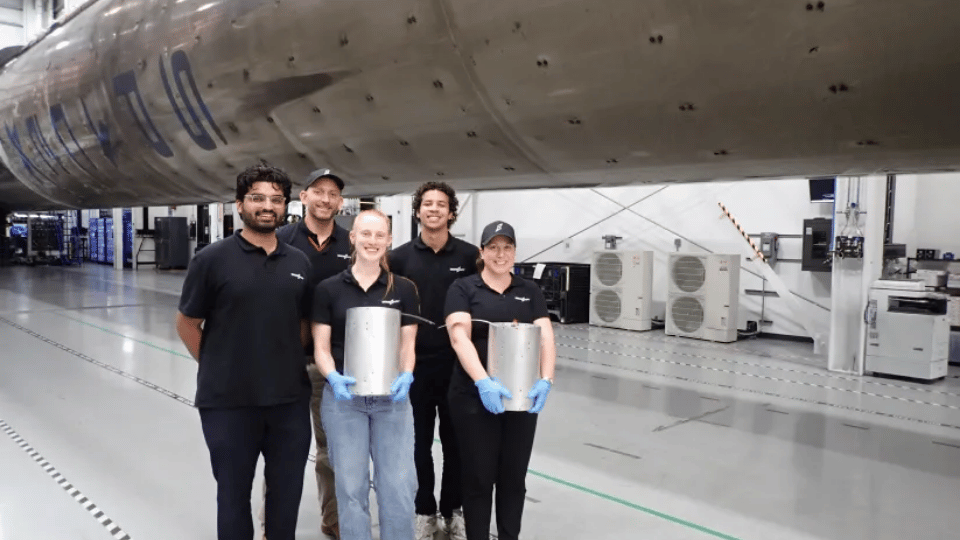
Former OpenAI team member Ashley Pilipiszyn founded Besxar to manufacture key precursor materials for advanced microchips by harnessing the natural vacuum of outer space. Earth-based chip fabrication facilities require massive, complex clean room facilities to block microscopic dust particles that ruin delicate silicon wafers during production. Pilipiszyn believes that using reusable launch rockets directly replaces that expensive terrestrial infrastructure.
To fund its orbital manufacturing goals, Besxar raised nearly 14 million dollars, including a 9 million dollar seed investment round led by Dauntless Ventures and Overture VC. Pilipiszyn explained that launching hardware into orbit costs less today than fighting Earth’s gravity and air physics to build pristine environments on the ground.
The startup built its initial testing prototypes, dubbed fabships, inside small metal canisters designed to process silicon samples during flight. Besxar launched its first two fabship canisters into orbit on a July Starlink mission aboard a SpaceX Falcon 9 rocket booster. The test aimed to prove that the protective canisters survive intense launch vibrations, shield silicon wafer samples from outside contamination, and expose test materials to the clean vacuum of space.
Besxar achieved its primary testing goals despite experiencing a minor data logging error in one canister. Post-flight analysis confirmed that the space-flown silicon samples showed the lowest particulate contamination levels compared to terrestrial control samples, giving the team a clean baseline to scale up operations.
Over the coming two years, Besxar plans to iterate its processing hardware across additional flights. The company eventually plans to deploy larger fabrication equipment aboard SpaceX Starship vehicles. Pilipiszyn originally approached SpaceX three years ago to discuss booking cargo space on Starship, ultimately choosing Falcon 9 boosters for early testing to de-risk core manufacturing hardware while Starship development continues.
Upcoming test flights will focus on heating silicon wafers in orbit, depositing thin film materials onto test surfaces, and layering multiple compound elements.
Once Besxar produces certified qualification samples, the startup plans to supply leading global chipmakers with raw processed wafers. These specialized wafers form the foundation for high-power management chips used in data center servers, industrial robots, and electric vehicles. The company takes its name from beskar, the fictional durable metal featured in Star Wars lore.
Other space manufacturing startups, including United Semiconductors and Space Forge, face similar operational challenges: retrieving finished silicon products from orbit at scale. Besxar expects to scale production from small test runs to thousands of processed wafers per manufacturing run, but achieving those production volumes depends on low-cost reusable heavy-lift rockets.
As commercial space launch services mature into reliable transportation routes, chipmakers can focus directly on specialized orbital processing. Using space conditions to build purer silicon materials bypasses terrestrial manufacturing limits, opening new possibilities for high-power electronic components.