
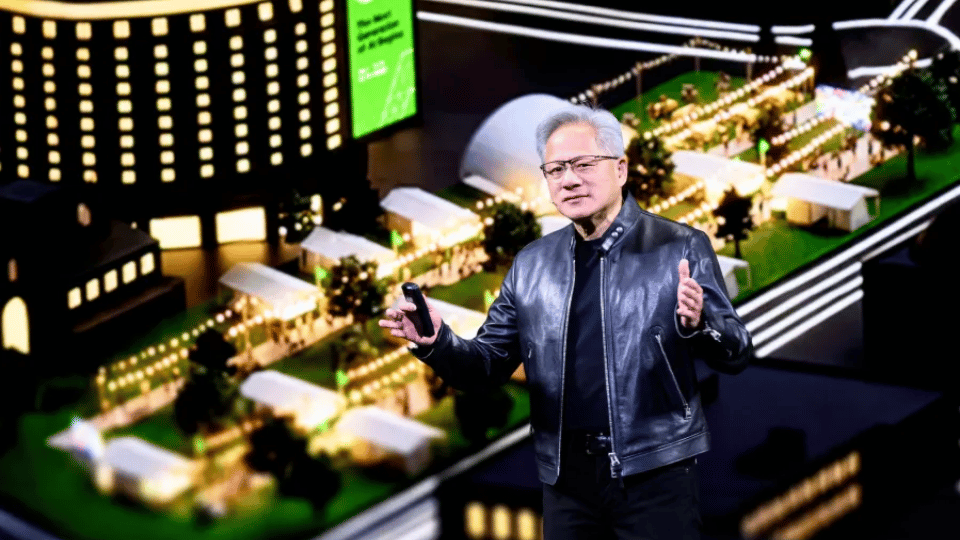
Nvidia CEO Jensen Huang addressed investors at the Goldman Sachs Communacopia and Technology conference, laying out why his company will sustain massive growth through next year. Despite widespread talk of market saturation and rising competition, Huang projected that Nvidia could grow revenue by an incredible 70 percent year over year.
Industry watchers regularly debate whether Nvidia can keep up its record pace. The hardware giant faces potential competition from hyper-scalers like Amazon, Microsoft, and Google, which build custom silicon in-house. Software labs like Anthropic and OpenAI explore alternative chip hardware, while rivals like Cerebras and Etched develop specialized processors to challenge Nvidia’s market dominance.
Huang dismissed the idea that Nvidia sells simple graphics cards. He explained that modern computing clusters require integrated architecture rather than standalone components. One modern system setup costs up to $3.5 million per unit, linking multiple processor chips, specialized networking setups, two million distinct parts, and 250,000 kilowatts of power into a single operational rig.
Huang highlighted rapid adoption for Nvidia’s combined systems that bundle 36 Grace central processors with 72 Blackwell graphics units. Orders for these integrated server racks currently grow 27 percent month over month, driving revenue expansion across global data center facilities.
Nvidia projects ending its current fiscal year with around $400 billion in total revenue. Generating 70 percent annual growth next year pushes total revenue toward $680 billion, a figure unmatched across the hardware industry.
Huang expressed confidence because Nvidia’s hardware stack forms the base layer for nearly every major software developer. Frontier labs like Anthropic, OpenAI, and Google build models directly on Nvidia hardware networks. The company maintains an early view into market demand by tracking land development, electrical grid allocations, and facility shell construction across global markets before developers order hardware.
When addressed about circular funding concerns, where Nvidia invests capital into startups that turn around and buy Nvidia chips, Huang brushed off historical comparisons to past tech bubbles. He noted that Nvidia invests small amounts relative to incoming revenue. He pointed out that every dollar invested brings back significantly higher customer hardware spending, making the investment loop highly profitable.
Huang added that Nvidia validates customer demand before committing capital allocations, ensuring companies hold real contracts and generating genuine consumer revenue. He reported seeing over $100 billion worth of verifiable customer contracts across the industry.
While native startups spending heavily on raw compute power drive short-term growth, software efficiency will improve over time. However, Nvidia maintains a deep hold on global hardware supply chains, setting up another massive revenue expansion for the coming year.